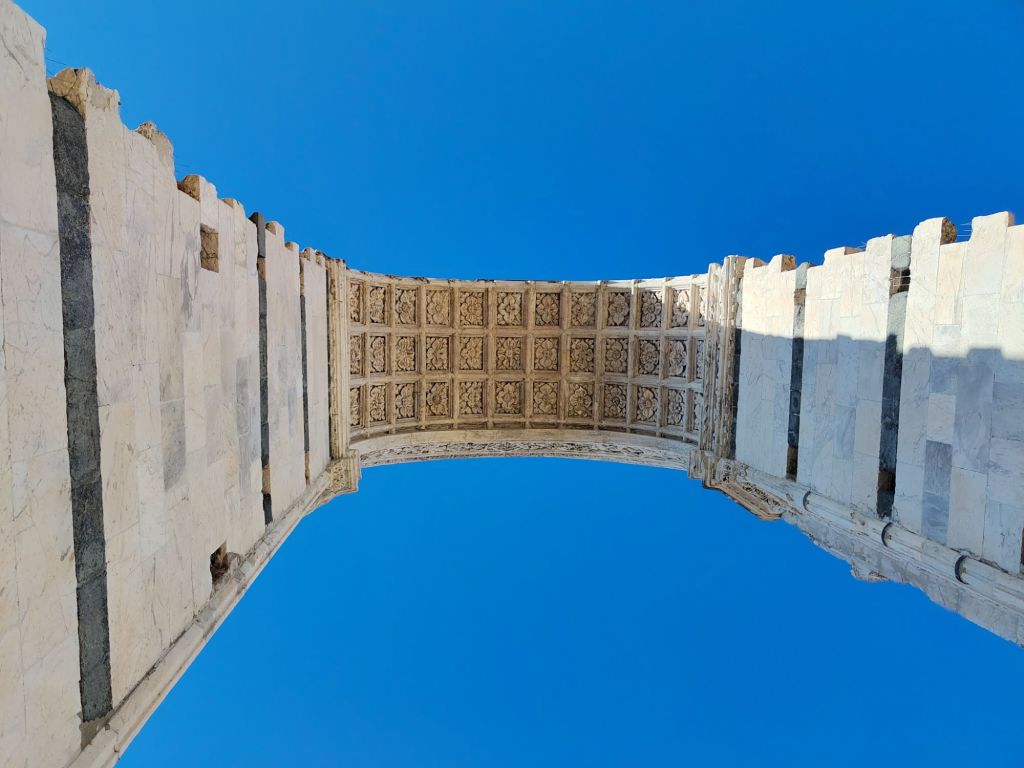
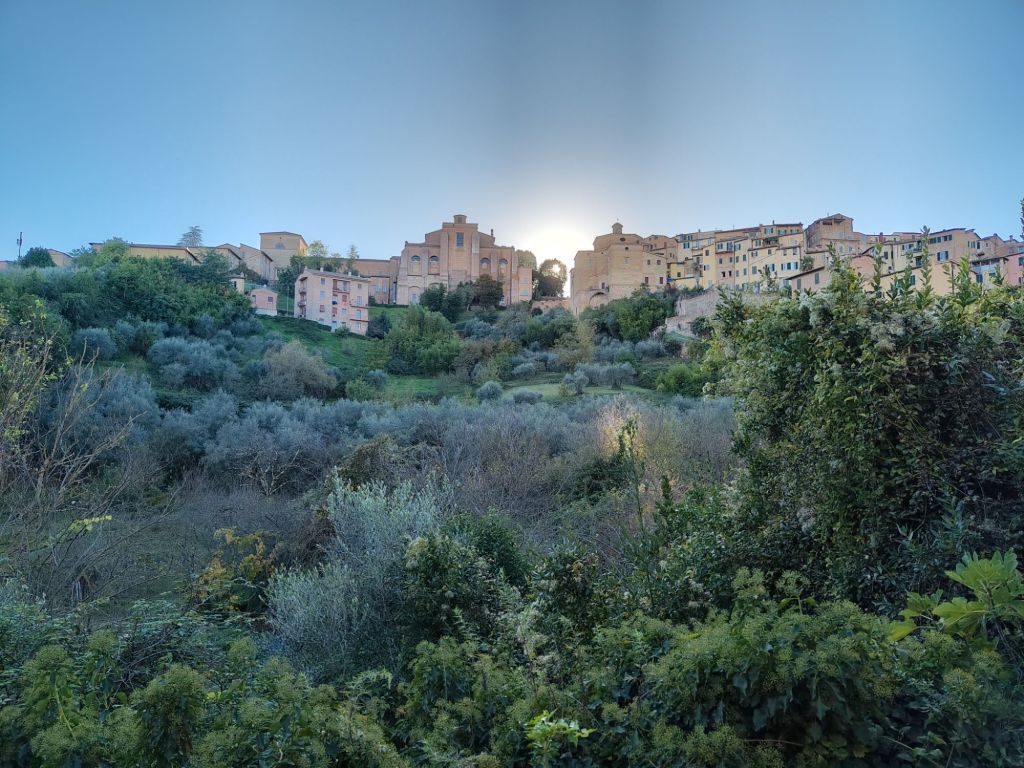
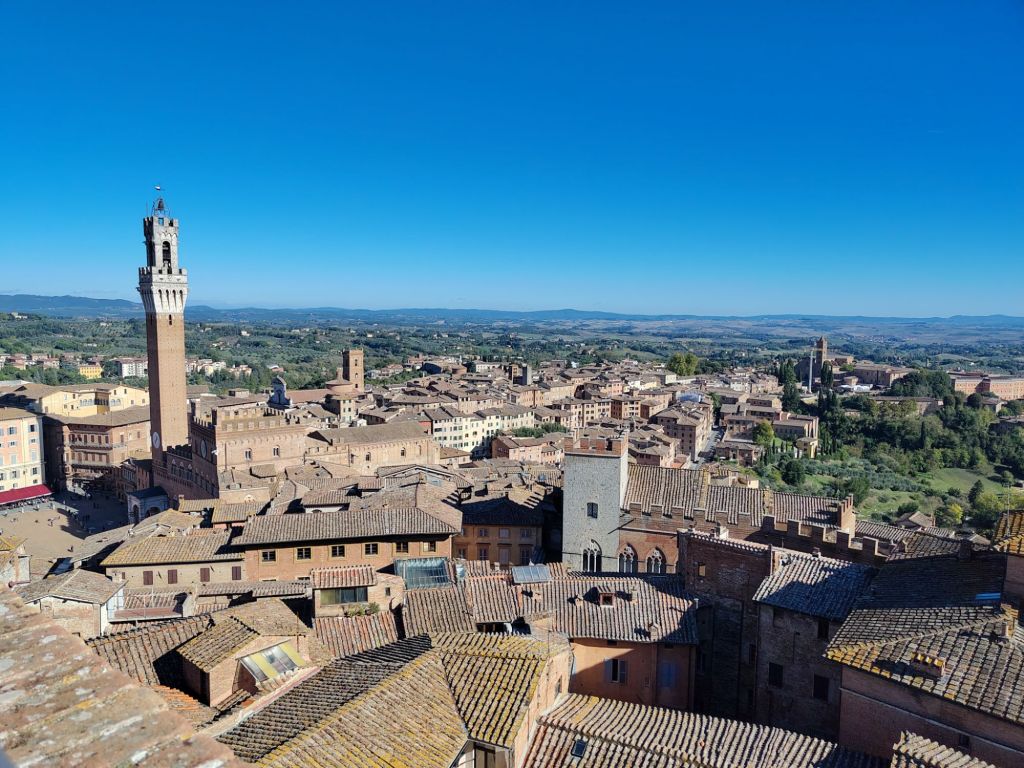
Siena and Tuscany are beautiful. Siena, famous for the Pallio horse racing that takes place twice per year, putting the 17 Contrade (neighbourhoods is the cloest approximation) of Siena up against each other, is bonkers. It takes place in the city centre, in the sqaure in the left-hand corner of the fourth photo, above.
The city is strong on local history – a pre-Roman setttlement, the archological museum in the Museo di Santa Maria della Scala (St Mary of the Ladder) helps picture the settlements in Siena and the reasons why the city looks the way it does today: there are stretches of land not built on within the old city walls – a surprise to see – but these fell into disuse during a plague outbreak and have not been used since.
We went for a walk in the Tuscan hills, too, taking the single-track train a couple of stops and walking back via some hills.
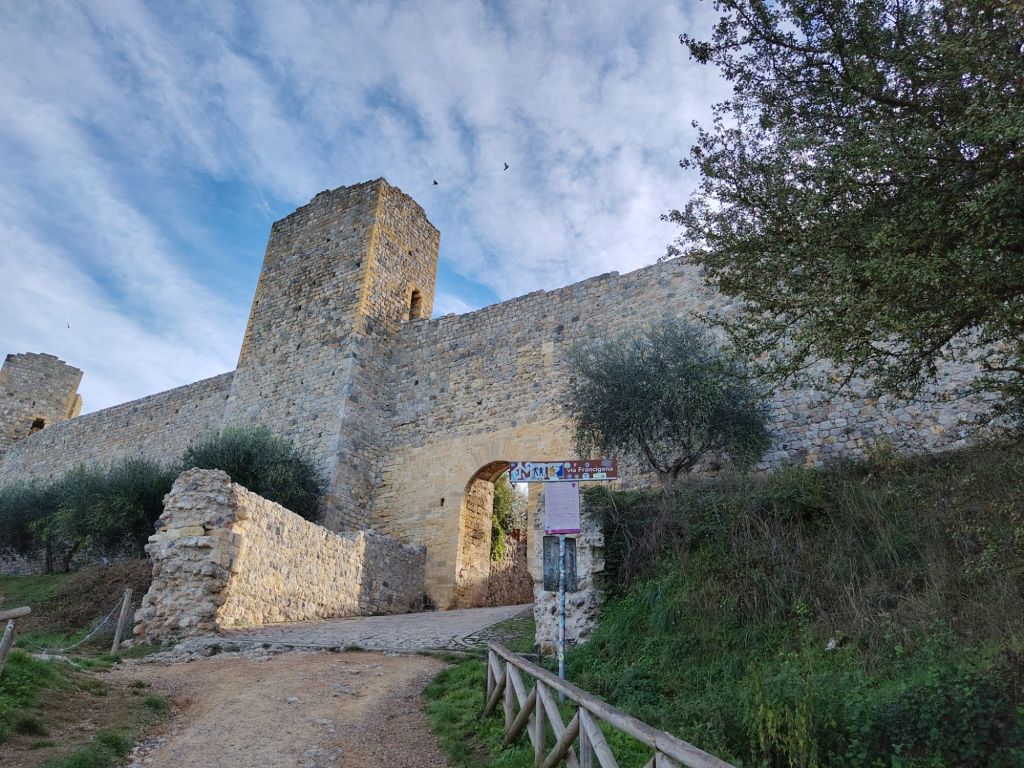
Monteriggioni is a lovely, tiny hilltop town with an intact defensive wall. This town, and a lot of the places we walked through, are on the Via Franciagena, an ancient Pilgrimage route from Canterbury to Rome. It was what one of the first series of the BBC Pilgrimage programme followed and is a route I would like to walk a lot of, come retirement.
The Tuscan countryside has good colours and smells. The earth is rich and dark, with clay and limescale smells mixed in; the colours of crops really stand out in contrast to the soil and the beautiful blue skies hat followed us around. We saw a hunter en route – he spoke with heavily accented Italian that I struggled to understand fully but I got the gist and I was able to communicate back, just about. He was interested in our walking route and making sure we knew where to head to – there were a lot of hunters in the woods that day, we think after wild boar – it features on a lot of menus and we saw quite often in the ground what looked like he ruffled earth of boars searching for truffles. A lot of the walk was in woodland, as yer man said to us, but there were moments of big views as well as commemoration – at one point, we reached a memorial for a few local families who had harboured partisans and members of the Italian resistance during WWII, often to great personal cost. It was sad, but also lovely and a bit inspiring, to see them remembered, close to their family homes.
After Tuscany, we had a long weekend in Turin and Milan on a football history tour with Aficionados. It was a chance to see a match at the San Siro stadium in Milan as well as learn more about Italian calcio and its impact on Italian culture. It was an excellent set of experiences – the volunteer-run Grande Torino museum a particular highlight as well as going onto the roof of the former Lingotto Fiat factory – the family who owned Fiat also had the majority share of Torino football club for a long time. The rooftop is now an open-air museum and art gallery with sensory garden and the chance to walk down one of the ramps for the factory, stil used for testing (electric vehicles only). As a sports fan including motor racing, this was a super experience. The Superga memorial ut of town is also very moving and we took some time to pay our respects.
And then to Milan – some time again in museum and the national cemetery for valuable historic insight and then the Mian derby at the San Siro. The San Siro itself – a 100 year old concrete cathedral to football – yes, she is an old dame and showing her age, but, my word, she is beautiful. Having spent time at the AC Milan museum (and met a lovely former player), we went to the San Siro to take in the atmosphere before entering by climbing up one of those distinctiive sprial ramps, and taking our seats in the sky, above the away end and the choreography – what an amazing spectacle put on tby the fans. I spent as much time watching them than I did the football, and t was a decent match, too.
The following day, we travelled to Verona for more football history, this time about Hellas Verona, meeting up with for a tour with a local fan (who is from Glasgow) and who has written an excellent book about the improbable but glorious win by Hellas Verona of Serie A in 1985-86, their only Serie A title. The fan bar we went to beforehand was a joyous experience – the match and the Ultra fans of Verona much less so. While Verona as a city is creaking into the 20th century (not a typo) in respect of equality and inclusion and recently elected a left-wing major who is making a positive difference (slowly, and fearlessly), the Ultras were quite clear that far-right ideology is the only way to live, and I, as an LGBTQ+ woman shold be thinking twice about my role in society and my atrocious, incorrect attitudes to, you know, other human beings.
I felt safe enough at the stadium as we were in a group, but also I have a super-power as a small, middle-aged woman – I disappear in plain sight. I am not the target market; I am not who the fascists are actually going to pick a fight with. While it is often frustrating being in putblic and have people try to walk through you or occupy the same dance-space because you are a tiny, middle-aged woman (‘sorry, love, I didnt see you!’) and, because, you know, male privilege, it comes in handy in times like this. I was completely ignored – the group of middle-aged British chaps was far more remarkable at Hellas Verona that day.
The group were lovely – we are still in touch in a WhatsApp group and people share their home and travelling football experiences. A few folks stayed on in Europe after our long weekend, taking in other Serie matches or French league (and non-league) matches. We have a couple of trips to other countries coming up – we will definitely look up if there is any match we can catch.
The week following this long weekend, we stayed in Trieste, a fascinating place that merits an entry of its own. I have written a couple of poems recently, too, which I will share soon, too.
I am grateful for this new job and the different timetable for life it has given me. It is hard work, which I prefer, and it is 42 hurs per week averag – I am now on the full rota so I have a better understanding of how this works over a six-week cycle. This week, I am on ‘spares’ – cover for colleagues’ annual leave, if anyone has anything booked, or if not, I can get out an about on the railway network and build up knowledge and relationships across the line. Yesterday was York, Hartlepool, Sunderland, Newcastle and Leeds, and tomorrow, if I stay spare, I will be heading south to Sheffield and Nottingham (the southern-most station served by Northern). On my next run, I will head up to the most northerly station as well as other routes that I know less well. I think a trip to the seaside might happen – Blackpool in winter, anyone?
Take care of you,
Cxx

