I’m currently back on a high-speed train, travelling up to Girona an then on to Carcassonne this evening. I’ve just completed 2 days in Barcelona and 3 days in Madrid. This has been my first trip to Spain and I very much hope not my last.
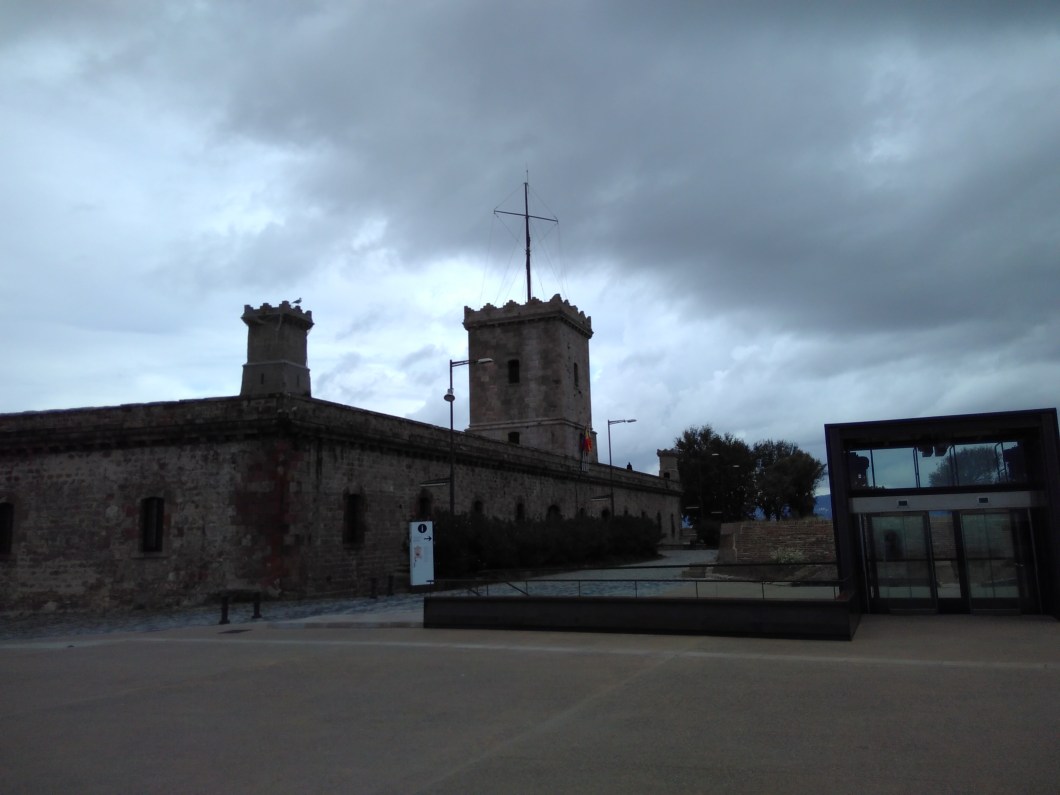
Barcelona is a super city with a very interesting history – the Maritime Museum is a great place to learn about the development of the city but also the Castel, which relays the story of Barcelona and that of Catalonia, and the Castel’s chequered past with the city it sits above. The same hill is said to be site of where Hercules scaled a hill to look for a lost ship; Barcelona was founded by the Romans and has been a (mostly) thriving port city ever since. The Castel was built on the site of what was known to be a look-out point and beacon for the port below (friend or foe ship arriving). In the 18th century, a stone fort was built as a formal defence for the city, housing a garrison and arsenal at various times. Not only used to defend the city, it has also had a role in falling in to enemy hands and being used to bombard its own city. During the Spanish Civil War, it was used as a prison and site for executions, including that of the Catalan President, Lluis Companys, at the time of Franco’s military coup. When the Castel was given to the city by the Franco regime in the 1960s, it was agreed to use it as a museum but it was only after Franco’s death that the city authorities decided to found a museum that told the truthful story of the site and of Barcelona, and attempt to make it the place of peace that President had envisaged in the 1930s.
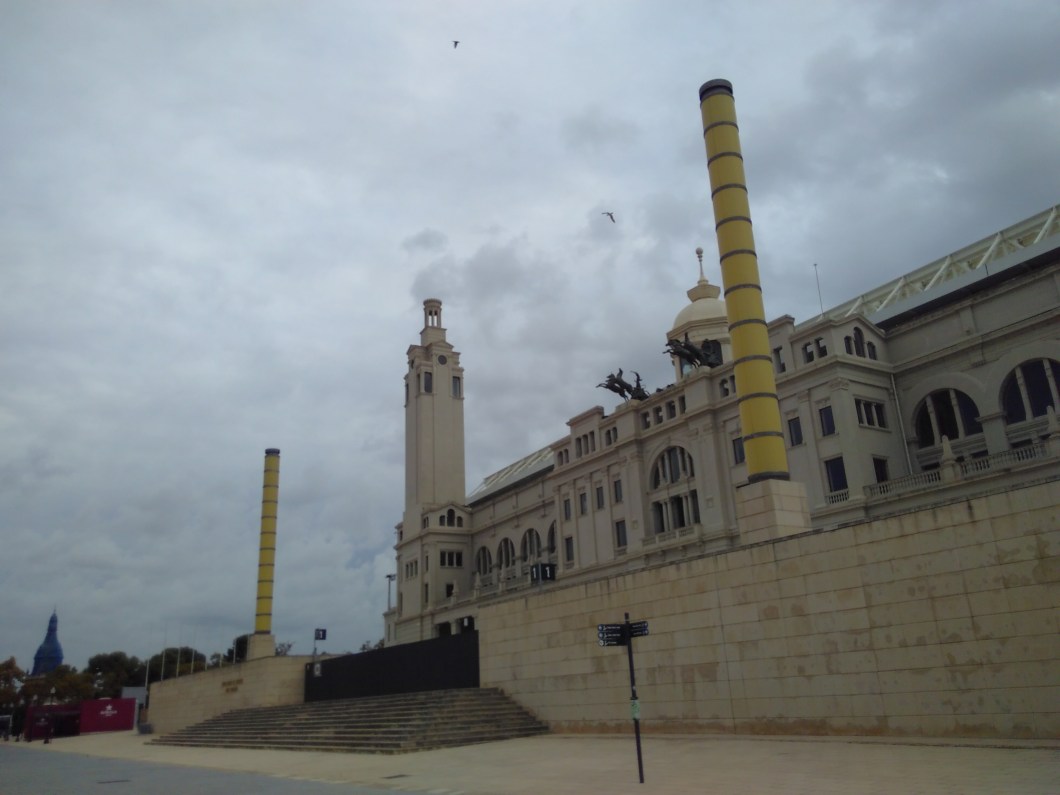
The same hill is also the site of the 1992 Barcelona Olympics. I had a lovely morning walking around the site, home of the athletics stadium, indoors stadium and a number of pitches. These are all still used for sporting and other events today. The 1992 Olympics were the first that I really got into in detail, having just turned 12 years old. There were British hopes (amongst others) in Sally Gunnel and Linford Christie. It was a great summer of sport (for me), with Andre Agassi’s first grand slam victory that July, too. As well as that, it was of course the Olympics of the song by Freddie Mercury and Monserrat Caballe, which has very much been part of my inner jukebox all week. I had learned a little about the recording sessions in Montreux between Freddie Mercury and Montserrat Caballe and it was good fun to break into song (early morning, by myself) at its Olympic venue.

Barcelona and Madrid are also home to some of Spain’s (and some of the world’s) best art collections. The National Museum of Art of Catalonia in Barcelona, the Prado, Reina Sofia and Thyssen-Bornemisza in Madrid have provided days of looking at masterpieces from all over the world, including very well developed Spanish collections, which made me realise how much Spanish art has remained in Spain as opposed to travel, as with the art of other Western European countries. Whether this was to do with the way the international art market has worked over time and to what extent Spain was part of the international art trade, as well as fashions in art and perhaps a will to maintain Spanish art in Spain, I’m not sure, but I’m keen to find out more. The Prado is hosting a number of special temporary exhibitions to celebrate its 200 year anniversary, theming them around masterpieces from the Prado collection and drawing on collections from all around the world. One such exhibition was the principal reason for the trip to Madrid, of Lavinia Fontana and Sophinsba Anguissola, two female Italian Renaissance artists, both of whom were enabled to make a living from being artists and produced beautiful works of art, which are now dispersed all over the world. The Prado, in wanting to celebrate female art as a particular theme, has used its considerable pull to put together an exhibition that would be very difficult to assemble again. We went to the exhibition on the first day it was open to the public and it was excellent. Having spent the morning just in that exhibition, it was very much a case of picking specific sections of the permanent collection, which is quite vast. The Reina Sofia houses Madrid’s modern art collection, from the 20th century onwards, most famously holding Picasso’s Guernica, which is devastating and such an important work of art to see. The way it has been curated as part of the permanent collection, with that part of the museum assembling art that was produced before, during and after the Spanish Civil War, building up to the tragedy of Guernica and the devastation of post-war Spain, was powerful and really well done. The Thyssen-Bornemisza was very interesting – not only a vast collection of Dutch, Italian Spanish and French Masters, but also Impressionist works (American as well as French) and also 20th century art of many different movements, including Cubist, Surrealist, Supremacist and a rare Vorticist. The museum takes the name of the collectors – it is a private collection assembled over decades by two generations of the Baron Thyssen and his respective wife, and given to the Spanish state in order to be put on public display and shared. Not only is it home to some of the world’s masterpieces, it is a really interesting glimpse in to the motivation and aesthetics of collectors of considerable wealth and connections. It would be very interesting to understand what the Baron and his wife, and the next generation, found aesthetically pleasing and therefore chose to buy, and which were the paintings, if any, which were the ones chosen as they were fashionable and made for a good investment in a collection. Given the sheer range, it felt like it would be a mixture, so again, it’s one for the reading list about which to find out more.
Onwards today – half a day to have a look around Girona and then Carcassonne for 2 days, before returning via Paris and Eurostar at the weekend.
Update en route!
I’m on a local train to Carcassonne – all being well, I will arrive in Carcassonne [I did] a couple of hours than I had planned, having given up the day in Girona. The reason for this is there were such severe storms yesterday in the south of France that part of the railway line between Bezieres and Sete is severely affected, which includes the high-speed line into France from Spain.
I arrived in Grona at 10.23 am as planned and was looking out for the left luggage place. I caught a glance at the departures board and saw that the 14.01 that I was going to catch to Narbonne for a Carcassonne connection was cancelled. Already! Girona station is in two parts and there didn’t seem to be a staffed information desk in the high-speed train section, so I trundled over to the main station where a member of staff told me that, yes, the train is cancelled and I should go back over to the high-speed section, directing me to the information desk that does exist – it’s in a posh lounge, so it didn’t look like it was for the likes of me. The member of staff said there were no trains at all to France today, and I should go over to the bus station to see if I might be able to get a bus to Perpignan or Narbonne. I was beginning to feel a bit kidnapped. I went to the bus station and the only bus to Narbonne was fully booked. I could get a bus to the airport and get a different bus to Perpignan but I had too much luggage – it was one bag maximum – so I wouldn’t be allowed on anyway. At that point, I remembered the final piece of information given at the railway station and that if I bought my ticket on line to check SNCF’s website for any more information, as I should be able to use my ticket on alternative services but it would need to come from SNCF’s info.
Hum.
I checked the website – thank goodness for data roaming – and the journey planner suggested a journey that I am now currently undertaking, which I should (should) be able to complete with my existing ticket [I was!]. I’m happy to argue my case if I need to!
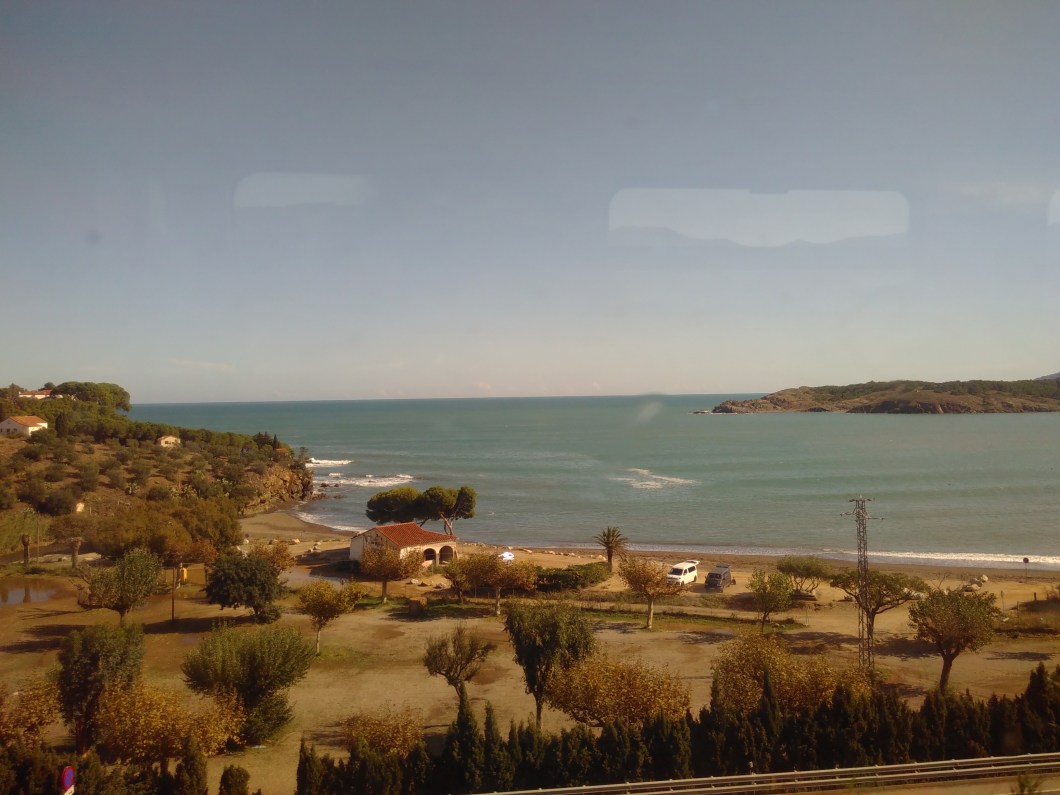
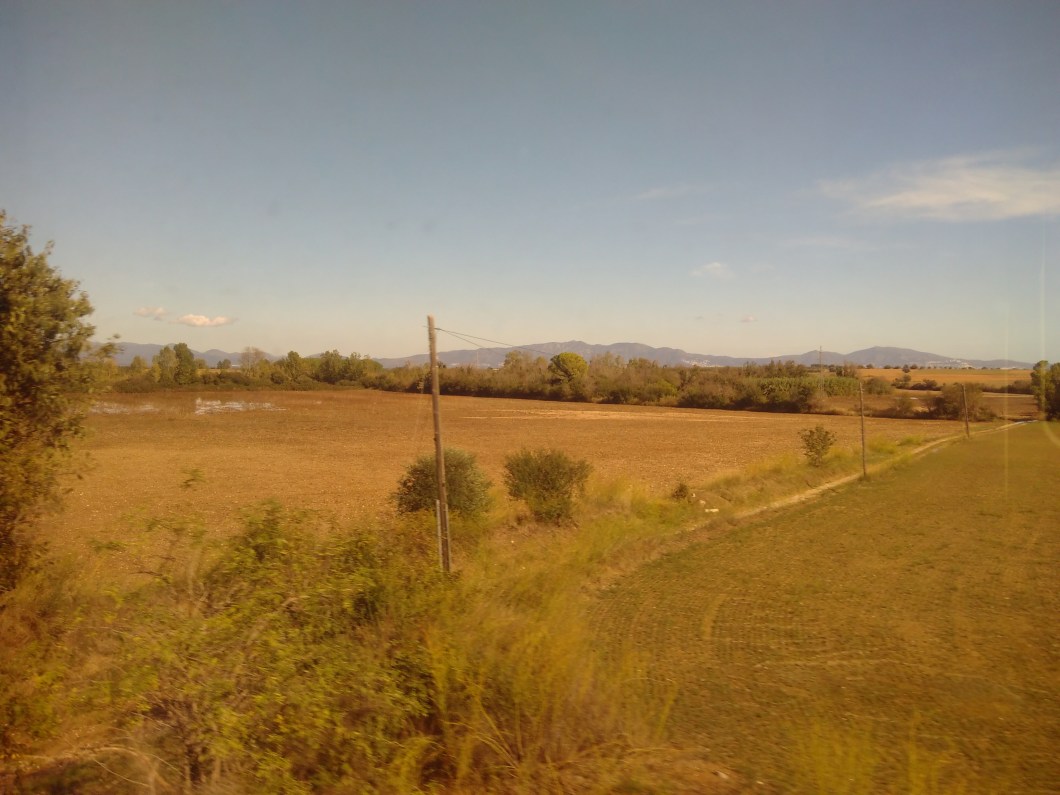
The alternative route is very lovely – high-speed trains have significant convenience factors but the local services are often coloured in green on my lovely train map, meaning particularly scenic – and this one is. I took a local Spanish train from Girona to Celebres, which is a station metres over the French border. Two cyclists got on the train at Port-Bau, which is the last Spanish station and is 7 minutes away from Cerebres. I wondered why, given how close the stations are. The train then spent 5 of the 7 minute journey going through a tunnel through the Pyrenees. I quickly understood why they took the train. That’s a lot of Vuelta d’Espagna terrain just avoided by going through rather than over the mountains. I picked up a connection to Carcassonne, which again goes over the local route – the coastal route via Collioure (and old friend and well loved by the Fauvistes) then hooking the route north at Narbonne. The journey has had views of the sea and the purple of the Pyrenees so although I was only able to manage a quick spin around Girona rather than half a day, I’ve been given absolute loveliness in the form of local rail journeys and the bonus of arriving earlier in Carcassonne, so I’ve used the Girona time in Carcassonne instead. C’est formidable!
 All the punks are pushing fifty years and are hardly feared