Lugdunun – my kind of town
You join me on the high-speed train from France to Barcelona. I was meant to be on a direct train from Lyon to Barcelona but there are unannounced rail strikes, which started yesterday in France. The CGT union has asked staff to participate in protest of working and safety conditions after a train struck a lorry at a level crossing on Wednesday. Checking t’internet this morning, and seeing my planned train cancelled, I cancelled my itinerary for a final morning in Lyon and set off early for Barcelona, which has hopefully calmed own after yesterday’s national protest highjacked by rioters. After an unexplained delay on the train to Valence to pick up an earlier Barcelona connection (something to do with 3 security guards trying to track down a suspicious youth), I made the Barcelona connection with 5 minutes to spare. The train has just passed through Nimes, an old friend from travels last year (the setting for last year’s Nimes-Nimes time-trial), itself a significant Gallo-Roman settlement, as is Lyon. It’s lovely to be passing through the rugged limestone and poplar trees of this part of Provence again.
But what about Lyon? Lyon is a super city. It has the best of everything I know about cities but it is a proud city in its own right. There is a handy City multi-pass for the museums and public transport, and the transport is a superb combination of boats, trams, trolley cars, funiculars and buses. I had a great time just bombing around and seeing the city.
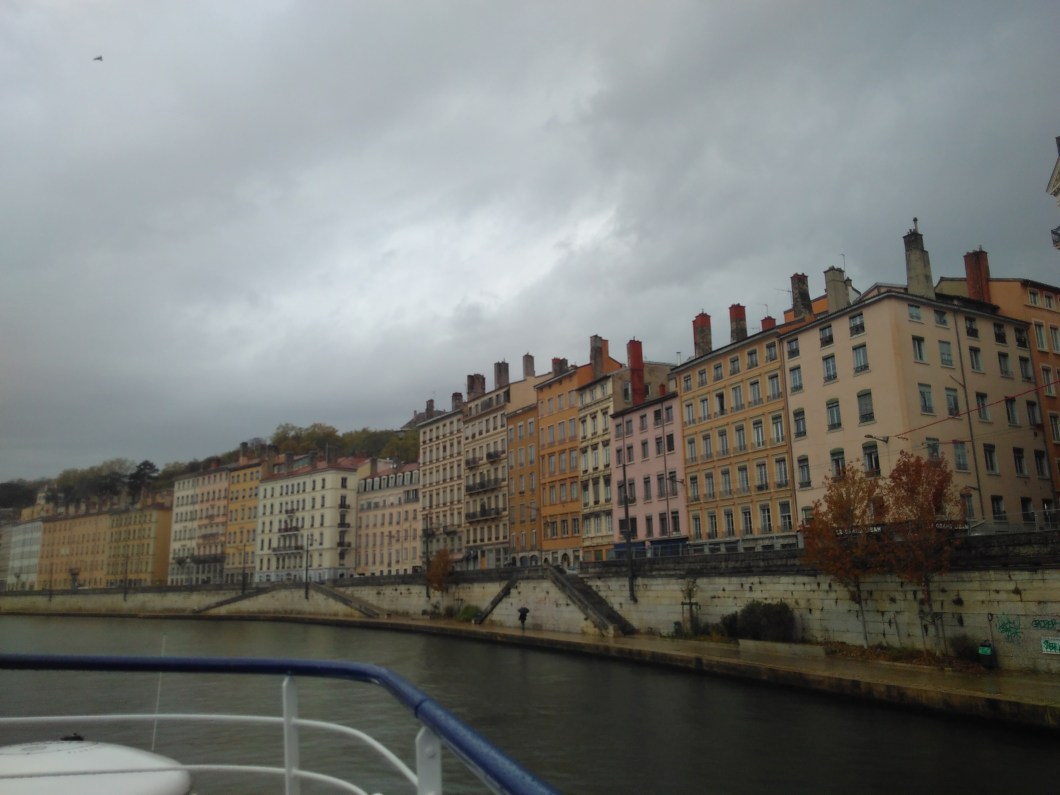
It has a gorgeous old town, which is the centre of tourism but not all of the main sights are concentrated there, which means that it’s not super crowded at this time of year. The museums I visited were top-notch and I spent more time than anticipated in the 3 I managed to get to. I fully meant to go to the Printing Museum or the local history museum this morning but rail travel needs overtook these. I did spend time in the History Centre for the Resistance and Deportation, the Gallo-Roman museum with Roman theatre and odeon, and the Fine Arts museum, as well as a boat trip with commentary. There were still many more museums to take in, including a Museum of the Confluence, where the Rhone and the Soane rivers meet, which is a science and anthropology museum.
Lyon has had a settlement since pre-historic times, up to and including a gallo-Celtic tribe from the Iron and Bronze ages who were already using the river Rhone for trade, particularly for wine. The Romans, seeing the strategic advantage point of the natural hill above the settlement, just down from the confluence, founded a Roman settlement, Lugdunum, on the hill and took over the Gallic settlement and the river port, bringing the usual Roman advantages of aqueducts, roads, sanitation (you know the rest) in 43 BCE. The Romans hung around until around 500 CE, after the fall of the Roman Empire in the main and gradually the Roman settlement became a mediaeval French settlement and Lyon grew along the banks of both rivers. After this, the main trade for a few centuries for Lyon, apart from food from the plentiful hills, was silk. Silk brought wealth as well as dictating the look of the city from the 1700s onwards, as buildings by the river were built with floors of a particular height to get as much benefit from natural light as possible and then, when a local merchant invented silk spinning machines, needed the height for the mechanism to fit in – typically buildings associated with silk weaving have floors with ceiling heights of around 4 metres, and look very handsome from the outside, too.
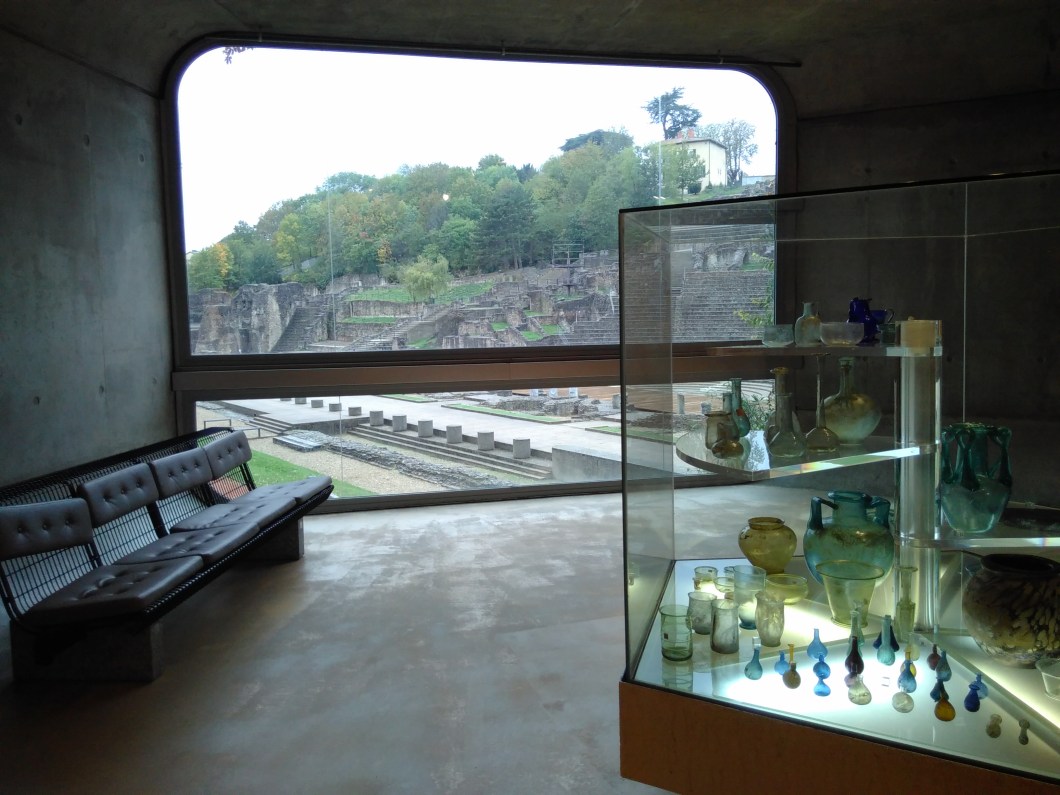
The Gallo-Roman museum is excellent – built in to the hillside that housed the upper tier of the Roman amphitheatre, from the theatre side, all you can see are two windows facing out. The inside is a symphony of concrete moulding, producing a museum that gently slops down through four floors of permanent exhibition and then to a final level of temporary exhibitions, in this case, one dedicated to games and toys of ancient times. The museum displays Roman mosaics, sculptures and other archaeological finds, and tells the story of the development of Gallo-Roman culture in this part of France, something I started learning about in Glanum outside of Salon-de-Provence last year. Lugdunum was one of the most important Roman settlements in southern Gaul and was large enough to have an amphitheatre and then a separate odeon for music built alongside it, a circus, as well as a large local settlement. Interestingly, whilst there are several references to the circus, the site of it has never been found. When we visited Naples earlier this year, the site of the Roman theatre was only discovered in the 1950s when a local archaeologist compared Roman records to the development of street plans over time and figured out where it was – the roof of the theatre is at basement level of modern-day Naples, which shows how much of the Roman town in Naples was covered over and built on top of. You can go on a subterranean tour of Naples, which I would well recommend, which ends with a secret way down in to the basement of a private house, in which you realise you are then in the old Roman theatre, the arches of which have been adopted in to the structure of basements for more modern buildings.
Back to Lyon, and the Centre for the History of the Resistance and Deportation was extremely interesting. The French Resistance, I realise, was not something I really learned about when studying WWII in school, and I am not entirely sure why. The museum detailed information about the Resistance that remained secret for many years, understandably, after the war, including the role of Allied forces in liaising with local Resistance groups, equipping and arming them, and evacuating individuals to Britain if possible and necessary. 20 years after the end of WWII, Lyon founded a local association for former Resistance members, which became a national association, and a means of collecting testimonies, interviews and artefacts from the individuals who were members of the Resistance, as well as official records from France and the UK that, over time, have started to be released. Lyon was a centre of the Resistance and a number of local people had a lot to offer when the association was formed, and a way of commemorating fallen comrades. The other element was collecting testimony about the role of occupied France in the deportation of Jews and other individuals to Death Camps throughout Europe. The museum has taken pains to be precise about Lyon’s role as an occupied city in deporting individuals: who the people were, where they lived, why they were on the deportation trains to internment camps throughout France and then, for those, the many thousands that did, which Death Camps they ended their lives at, and the few who were able to come home. This type of museum I’m sadly more used to, and will always take time to go around. As interesting was the information about the trial of Klaus Barbie, who was posted to Lyon during the war and the specific war crimes for which he was arrested and tried in the 1980s were documented and detailed from his time specifically in Lyon, with many local people providing witness statements at his trial. His conviction was an important moment for many local Lyonnais as well as the post-war world.
Lyon boasts an excellent fine art collection, not only 19th and 20th century paintings that are very much de rigeur for any such French museum, but also a serious collection of fine art from 14th-17th Century Europe as well as antiquities as art – Roman and Greek sculptures, Islamic and Byzantine vases, cloth and glassware, not only displayed as museum pieces but curated as part of an art collection spanning 2,000 years, showing how art movements linked to developing civilizations were influential and valuable to each other. This way of curating historical artefacts in their artistic setting was super. It also meant that I spent the whole day in the museum, finishing just in time to get the last boat trip of the day, during which the rain did hammer itself down, but it was a big boat with many seats under cover, so I wimped out, despite my British waterproof and normal grit in the face of rain.
Several hours later . . .
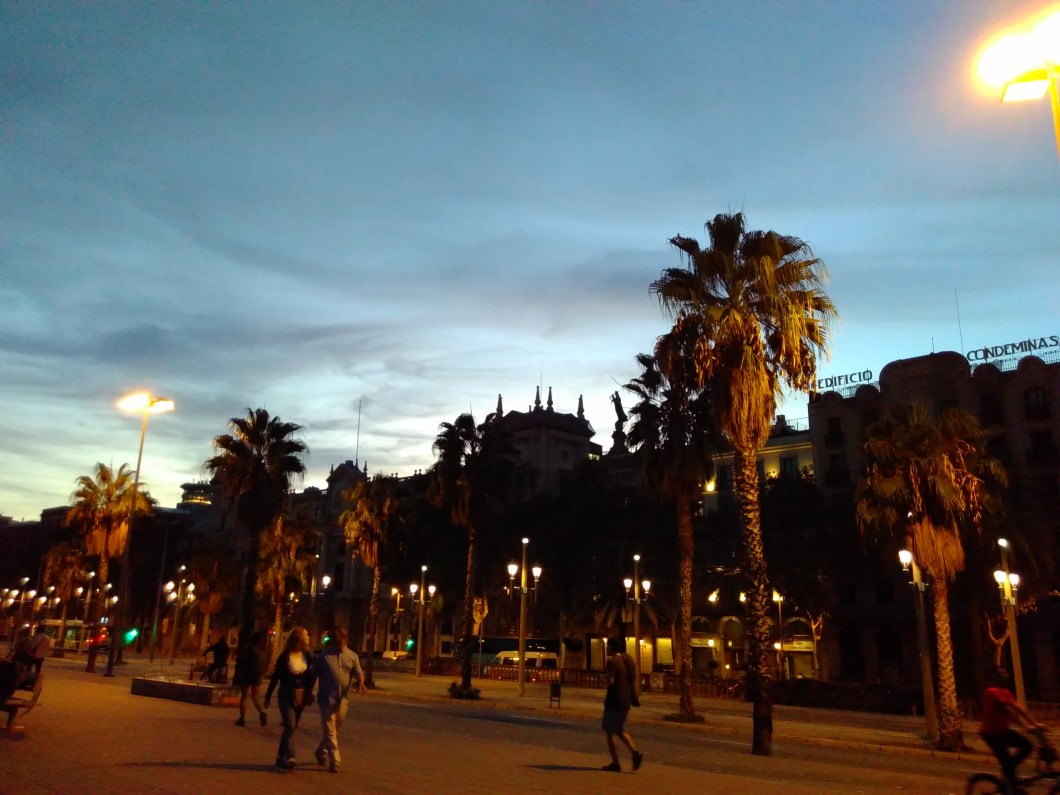
I have arrived in Barcelona and had an initial look around. I very much enjoyed the sunset down at the harbour and a walk around the main city centre area. The main roads are closed off this evening – whether this is a hang-over from yesterday’s protests or something else, I’m not sure. The city has completely calmed down after yesterday’s national day of protest, which is an annual event, sadly highjacked by some violent individuals who were intent on carrying on their attempt at a firefight with the police. There was heavy police presence but nothing going on for the police to react to, in respect of what I could see. I have a full day in Barcelona and Monday morning, then Madrid. Buenos noches.
 All the punks are pushing fifty years and are hardly feared