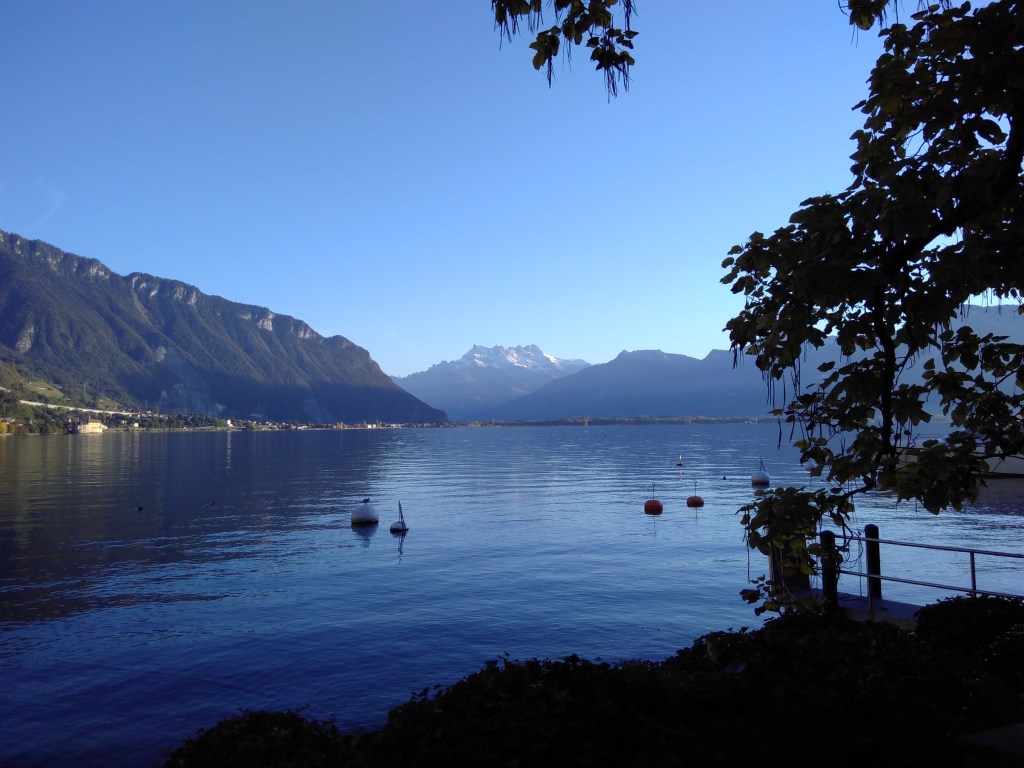
I’m back in Montreux. It is just as beautiful as I remember it last year (in case you missed it please see here).
It’s been an amazing 3 days of exploration. Wednesday was a day in Ravenna – I’d heard a lot about the stunning mosaic art, left over from the 5th-6th century Byzantine period in this part of Italy, particularly well preserved in Ravenna, itself a lovely little town.
J and I went to Pompeii and Herculaneum earlier this year and I wasn’t keeping a blog then – I will go back and write up some of the experience as it is one I would recommend to anyone who wants to experience something familiar but different – there are a lot of human connections you can make in a set of ruins. A lot of what is intact or restored is Roman mosaic flooring and wall decorations. The Byzantines were as skilled in their mosaic artistry but used COLOUR. The results are amazing.
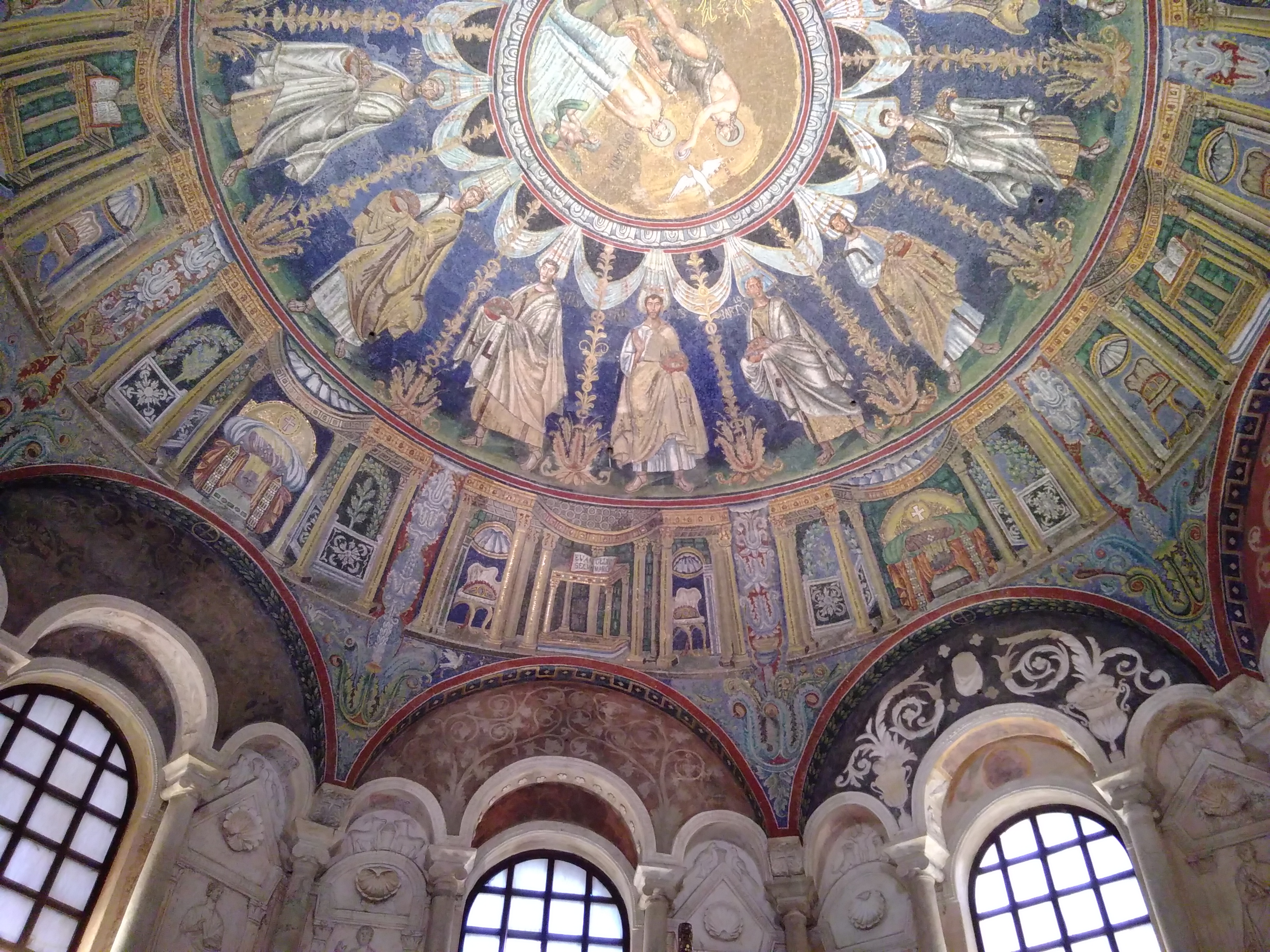
It is hard to take in that this is all mosaic tiling. The detail and the story-telling are fantastic. There are several baptistries and churches with this sort of mosaic artwork intact and well worth a visit. I’ve been intrigued by this part of history, particularly after reading ‘The Silk Roads: A New History of the World’ by Peter Frankopan, a historian who brings together the history of the trade routes that so influenced the development of conquest, culture, language, the concept of luxury and value and the distances as well as the closeness between peoples.
Ordinarily, something completely different would be Thursday but there are links, not even perhaps entirely tenuous. On the train to Ravenna, I saw that the route went through Imola, a town known to many motor racing fans, home of the San Marino Grand Prix, the place where several racing drivers including Ayrton Senna, were killed and a track missed by many from the F1 calendar. The track still holds an F1 licence, maintained after the track made modifications, and there was talk that the Italian Grand Prix might move to Imola had Monza not agreed terms of a new contract. Imola continues to hold race events and the Peroni Cup was in town – I was too early for the racing but the teams had already moved in to the pit lane and I saw many a loud Porsche being tweaked in the garage.
I found all this out as I looked up the race track to see what was going on and whether there was a museum or something to visit when racing was no on. There is a museum – at the moment it has a temporary exhibition about Ayrton Senna, which was excellent in terms of its content, sensitivity and also the exhibits – three of Senna’s F1 cars and his kart from his mini-Senna days were included.
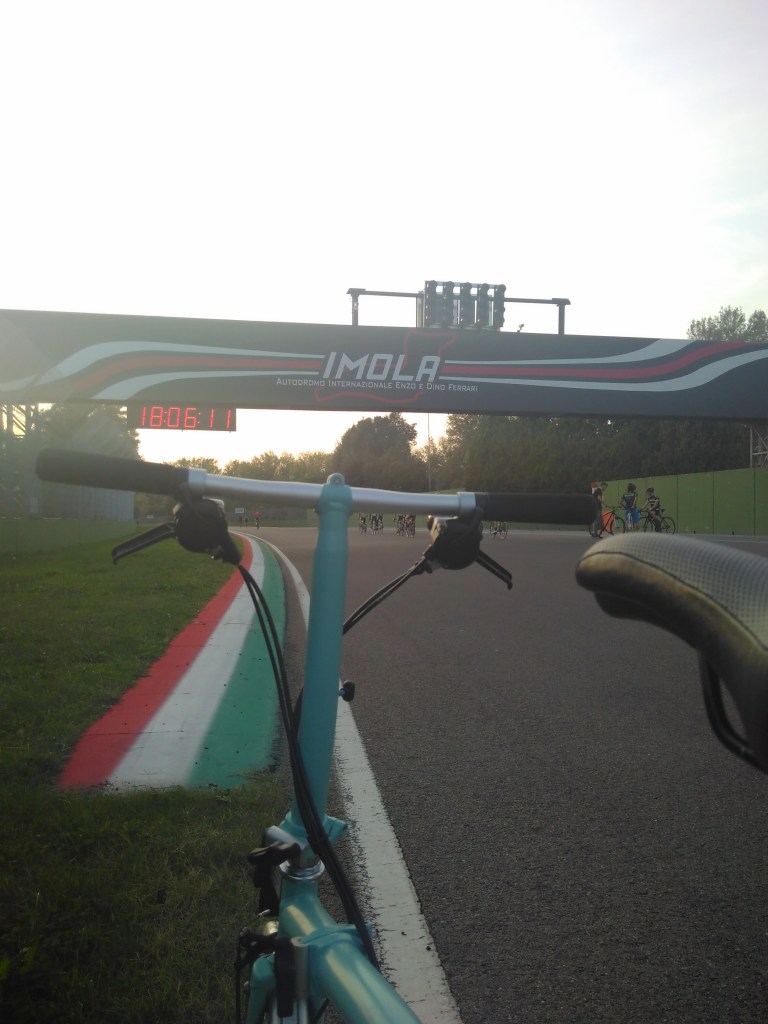
Also when looking up the track, the website banner mentioned ‘open days’. I checked the Italian and English versions of the website when I read more: 2-3 afternoons a month from April – November 2019, the track is opened up for 1.5 hours to pedestrians and people on ‘non-motorised vehicles with rubber tyres’. The photo showed a crowd of people and cyclists walking down the start-finish straight. And joy of joys, one such afternoon was Thursday! I spent the morning in Bologna, finishing an itinerary of museums and was almost peeing my pants with excitement on the train to Imola. It’s 20 minutes from Bologna on the train, and with me was Betty the Brompton, my very own ‘non-motorised vehicle with rubber tyres’. I cycled through town and took a look at the Pinacoteca of the Diocese and the Carriage Museum – both were free and I’d arrived early in Imola to see the town a bit. I headed down to the racetrack and took in the Ayron Senna exhibition, before which I asked the lovely lady at the information desk whether my understanding of what an Open Day was correct. It was. And I have a bicycle – may I take that on to the track, please? ‘Certainly – with pleasure,’ was the answer. I think she was a little surprised at my enthusiasm at her answer.
At 17.06 the gate coming up to the end of the pit lane was opened and I joined 20-30 walkers, runners and cyclists going through the gate and under the lights on the start-finish straight. I bombed around my first lap (5km, anticlockwise) and was grinning from ear to ear. The lovely lady had given me a map of the track, which is excellent as I can get lost on a racetrack, but I knew this one a little and this gave me an idea what else to look out for, such as the fan memorial to Ayrton Senna, which is just past turn 2. I completed a flying lap, 4 hot laps and a warm-down lap in the allotted time and had to be reminded to leave the track – I was a bit mesmerised by being there and the gorgeous sunset that was ending with the session.
Twelve minutes later, I had cycled across town, folded up Betty and boarded the next train back to Bologna. The connection is connections – a lot of the journeys any of us take are to make connections with something or someone that has gone before. A lot of people remark at Pompeii that you can see the grooves that carriage wheels have made in the stone roads.
Today has been a visit to a place I fell in love with last year, which I visited again for a sense of connection and a pilgrimage of sorts. Montreux was home to Mountain Studios, which was owned by Queen from 1978 – 1995 and where the last 4 Queen albums and a lot of other material recorded and mixed. I love the train journey from Italy to get here; from Milan, through the Italian lakes, up and through the Alps and down to Lake Geneva. I had disembarked from the train and was just pushing Brompton down the road from the station to get my bearings and someone leaving their building stopped and saluted – a fellow Brompton rider! That was lovely. I cycled around to the Youth Hostel and spent the evening on the lake-side. The views have not lost any of their magic. The photo above is just one of many taken today – the colours here are unbelievable. Freddie’s lyrics on Made in Heaven about Montreux still ring very, very true.
 All the punks are pushing fifty years and are hardly feared